
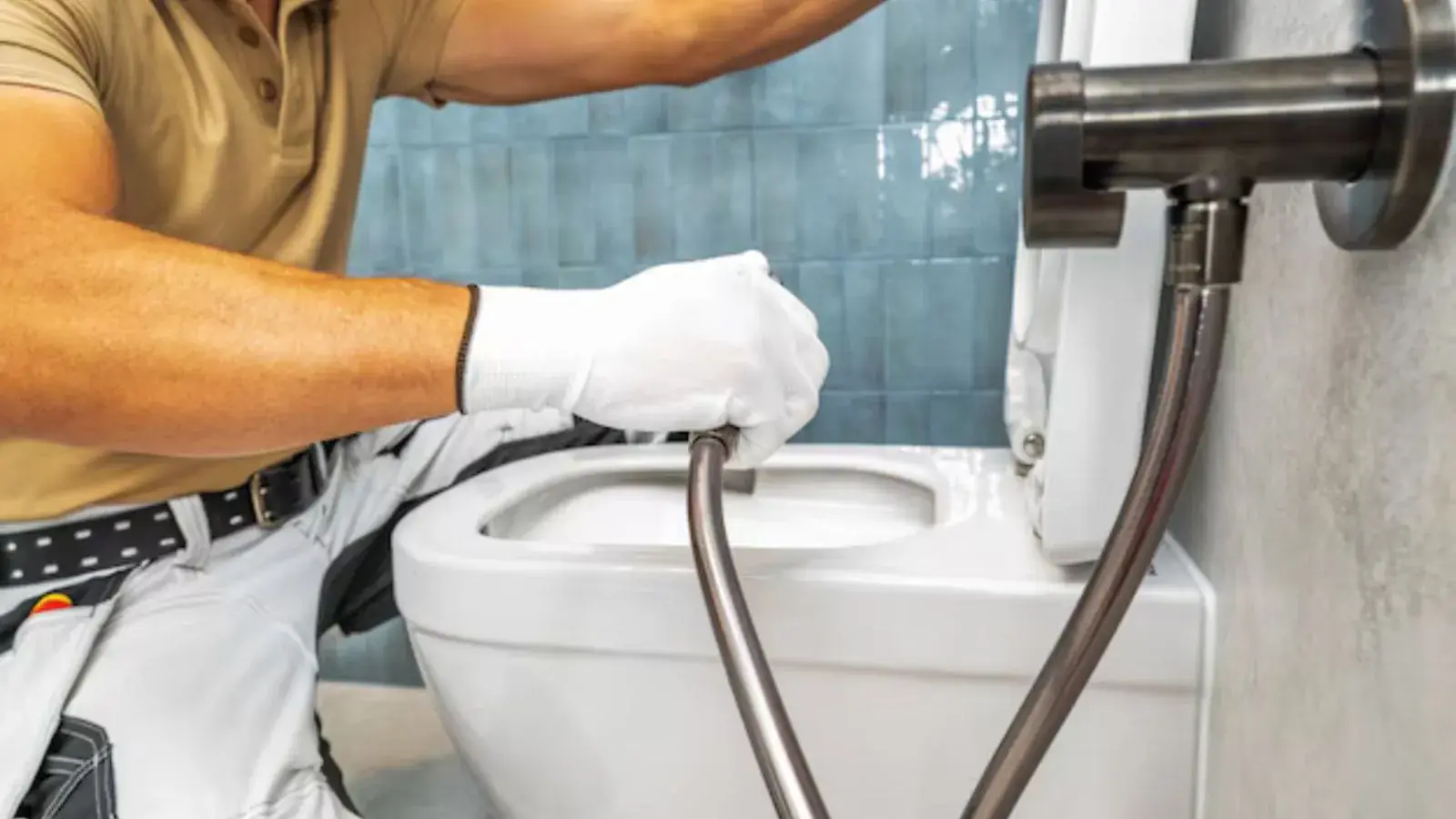
Why the plunger fails.
A plunger works by pushing and pulling a column of water against a clog. It fails when the plunger is the wrong shape, the seal is poor, the clog is a solid object or the blockage sits beyond the toilet itself. A flat cup plunger made for sinks does a poor job on a toilet. A flange plunger, with a fold out rubber extension, seals the drain opening and moves much more force.
Stop after a few honest tries. Repeated plunging against a solid object just packs it tighter. If the water level is rising, stop and shut the supply valve behind the toilet before you do anything else.
Try these in order.
Shut the valve and lower the bowl.
Turn the valve behind the toilet clockwise to prevent overflow, and bail out excess water if the bowl is near the rim.
Use a flange plunger properly.
Seat it over the drain, push gently to push out air, then pull and push firmly for about twenty seconds.
Try a toilet auger.
Feed the cable into the drain, crank to hook or break the clog and withdraw it carefully to avoid scratching the porcelain.
Flush with a bucket test.
Pour a bucket of water into the bowl and see whether it drains. If it does, the clog is cleared.
Need a plumber for this?
Call the 24/7 line and a dispatcher will help you right away.
What the symptom tells you.
Our toilet repair page explains what we do when the toilet itself is at fault.
| What you see. | Likely meaning. | Next step. |
|---|---|---|
| Water drains slowly after plunging. | Partial clog in the trap. | Auger the toilet. |
| Water rises when you flush another fixture. | Clog in the main line. | Stop and call a plumber. |
| Gurgling in a nearby tub or sink. | Air pulled through a blocked line. | Call a plumber. |
| Plunging does nothing at all. | Solid object or heavy wipe clog. | Auger or have the toilet pulled. |
| Bowl empties but refills quickly. | Possibly a vent or trap problem. | Call a plumber. |
Common reasons a toilet clogs again and again.
Too much paper.
Thick paper in a low flow toilet overwhelms the trap.
Flushable wipes.
They stay intact and snag at pipe bends.
A hard object.
Toys, razors and similar items lodge in the trap.
A weak flush.
Hard water scale or a low tank level reduces flushing power.
A partial main line clog.
Several fixtures drain slowly together.
A cracked or misaligned flange.
Water leaks under the toilet or the drain feels loose.
Do it yourself or call a plumber.
Avoid chemical cleaners in a toilet. They sit in the bowl and can splash back or damage the finish.
Reasonable to try.
- A flange plunger for a paper clog.
- A toilet auger on a stubborn plug.
- Checking the tank water level.
- Using a bucket of hot tap water to loosen soap or grease.
Call a plumber for.
- Water rising in other fixtures.
- A toilet that clogs every few days.
- Sewage smell or gurgling in drains.
- An object you cannot reach.
Rather have a pro handle it?
Call to ask about timing.
When a clog is really a main line problem.
If a second toilet or a floor drain acts up while you plunge the first one, the blockage is not in the toilet. It sits in the line they share. Plunging will not reach it, and forcing more water through the system can push sewage into the lowest fixture in the house.
In that case, stop using water and call us. Our drain cleaning service clears the main line with a cable or a jetter and can inspect it with a camera.
Stratford note: know your sewer connection.
Not every Stratford home sits on the same sewer arrangement. If you are unsure whether your street has public sewer, ask the Stratford Water Pollution Control office, and call 811 before any digging near a line.
Neighbors in Bridgeport and Milford should ask their own sewer authority the same question, since main line responsibility can differ by town.
According to the Connecticut Department of Consumer Protection, you can check whether a contractor holds an active license through the state eLicense lookup, which is worth doing before any plumber starts work.
Prevent the next clog.
Use a moderate amount of toilet paper and flush in two parts if needed. Keep wipes, feminine products, dental floss and paper towels out of the bowl. Keep a flange plunger and a toilet auger in the bathroom so you are ready in a minute. If a toilet clogs repeatedly, have a plumber check the flange, the vent and the line behind it.
A toilet that flushes weakly may need its fill valve or flapper adjusted. That is a small repair that can head off a bigger problem.
Questions we hear.
The plunger may be the wrong type, the seal may be poor or the clog may be solid or deeper in the line. A flange plunger and an auger solve most cases.
It is not recommended. It can sit in the bowl, damage fixtures and splash back on you or the plumber.
Other fixtures gurgle or back up when you flush or run water. That calls for a plumber.
Not necessarily. Ask the Stratford Water Pollution Control office about your address.
A toilet auger with a protective sleeve is designed to avoid that. Feed it slowly and keep the handle steady.