
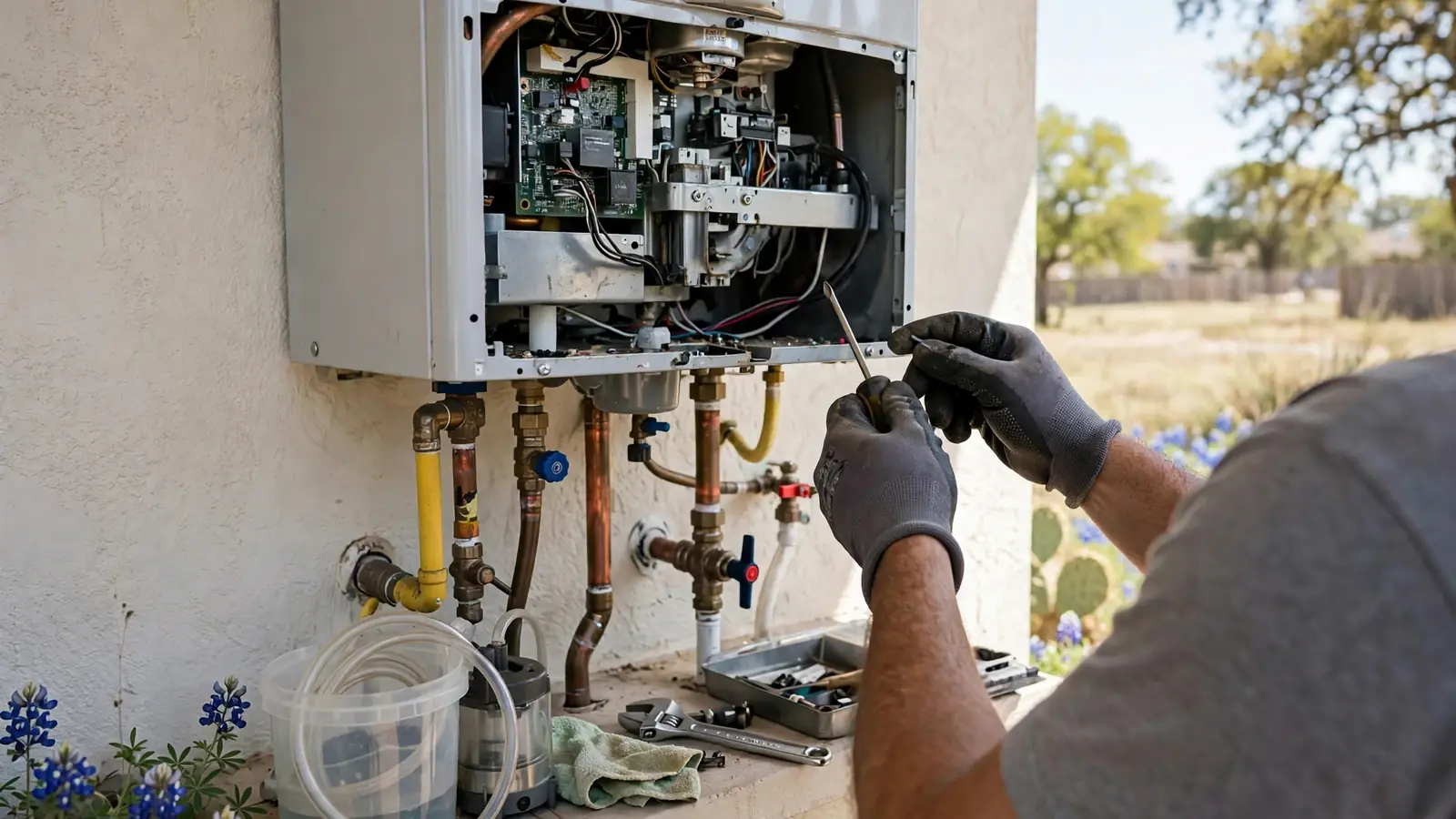
Tankless water heater service in Stratford, CT.
A tankless water heater warms water only when a tap opens, using a burner or electric element and a heat exchanger instead of a storage tank. Service covers installing a new unit, repairing faults and the periodic flush that keeps the heat exchanger clear.
Because the unit heats water on demand, size and gas supply matter more than with a tank. A unit that is too small, or fed by an undersized gas line, will deliver lukewarm water at peak demand no matter how new it is.
The three jobs tankless owners call about.
Install.
Sizing, gas line, venting, condensate drain and a water shutoff kit with service valves.
Flush and descale.
Circulating a descaling solution through the heat exchanger to remove mineral buildup.
Repair.
Reading the error code, then fixing sensors, igniters, fans, flow meters or controls.
Flushing and descaling: what it does and how often.
Minerals from tap water slowly coat the inside of the heat exchanger. The coating makes the unit work harder, raises exhaust temperature and can trigger error codes. A flush uses a pump, hoses and a descaling solution to circulate through the exchanger for roughly an hour, then rinses it clean.
Manufacturers commonly call for a yearly flush, and some call for more often in hard-water areas. Because Aquarion's 2025 Eastern Fairfield County report lists average hardness at 3 grains per gallon, a yearly flush is usually a reasonable schedule here. Your unit's manual sets the official interval, so we follow it.
Common tankless problems and what we check.
Cold water sandwich.
A burst of cold water between hot flows can come from short run times or a clogged inlet screen.
Error code on the display.
We read the code, then test the sensor, igniter or fan it points to rather than swapping parts blindly.
Water never gets hot enough.
Scale, a low gas supply, a closed valve or a crossover between hot and cold lines can all be the cause.
Fan noise or exhaust smell.
Venting problems must be corrected, because combustion gases need a clear path outdoors.
Pilot-free ignition failures.
Modern units fire with an electronic igniter, which can foul with dust or fail with age.
Low flow at faucets.
Clogged inlet filters and partly closed isolation valves restrict the flow the unit needs to fire.
Is tankless right for your home.
We will help you decide by looking at your gas meter, vent path and daily hot water use. If a tank is the better fit, see water heater replacement.
Tankless suits you when.
- You want continuous hot water for long showers.
- Space on the wall or outside is limited.
- You are willing to maintain it yearly.
- The gas line and vent route can be upgraded.
A tank may fit better when.
- The house has a small gas line and no vent route.
- Budget for the first install is the main limit.
- Several fixtures run at the same time often.
- You want the simplest swap with the least change.
Questions about a tankless unit?
Call to book an install, a flush or a repair visit with a plumber.
Gas line and venting: the part owners underestimate.
A tankless gas heater can need a larger gas line than the tank it replaces, because the burner uses far more fuel at once. Venting changes, such as stainless or polypropylene runs through a wall, are also common. We check both before quoting, and we coordinate permit questions with the Stratford building department when the work calls for it.
Electric tankless models avoid the venting but ask a lot from the electrical panel. If your panel is full, a new circuit or an upgrade may come first.
What shapes tankless pricing.
You get a clear price before we start, and these items drive it.
If your home is within a utility rebate program, ask before purchase, since incentives change.
Tankless in Stratford homes.
Stratford homes vary, from basements to utility closets, and the location of the heater decides which tank or tankless unit fits. Moving to a wall-mounted unit frees that floor space, but it moves the work into venting and gas piping, so plan on a walk-through before choosing.
Ask the Stratford building department about permits for gas appliance work, and keep the manual and installation papers for any future flush visit.
The U.S. Consumer Product Safety Commission urges users to lower their water heaters to 120 degrees Fahrenheit to reduce the risk of tap water scalds, so ask the plumber to set the thermostat with that guideline in mind.
Questions we hear.
Yearly is the common recommendation, and your manual sets the exact interval. Stratford's water is on the soft side per Aquarion's 2025 report, but flushing is still part of normal care.
Codes point to the area that failed a check, such as ignition, flow, venting or temperature. We read the code and test the part it names.
Usually, but the gas line, vent route and panel capacity must support it. We check before quoting.
They give continuous hot water up to the unit's flow limit. Running several fixtures at once can exceed it.
We service common residential models. If a unit needs manufacturer-only service, we will tell you at the start.
Shut off the water and power or gas at the unit and call us. For a leaking or failed tank, our water heater repair page covers emergency options.