
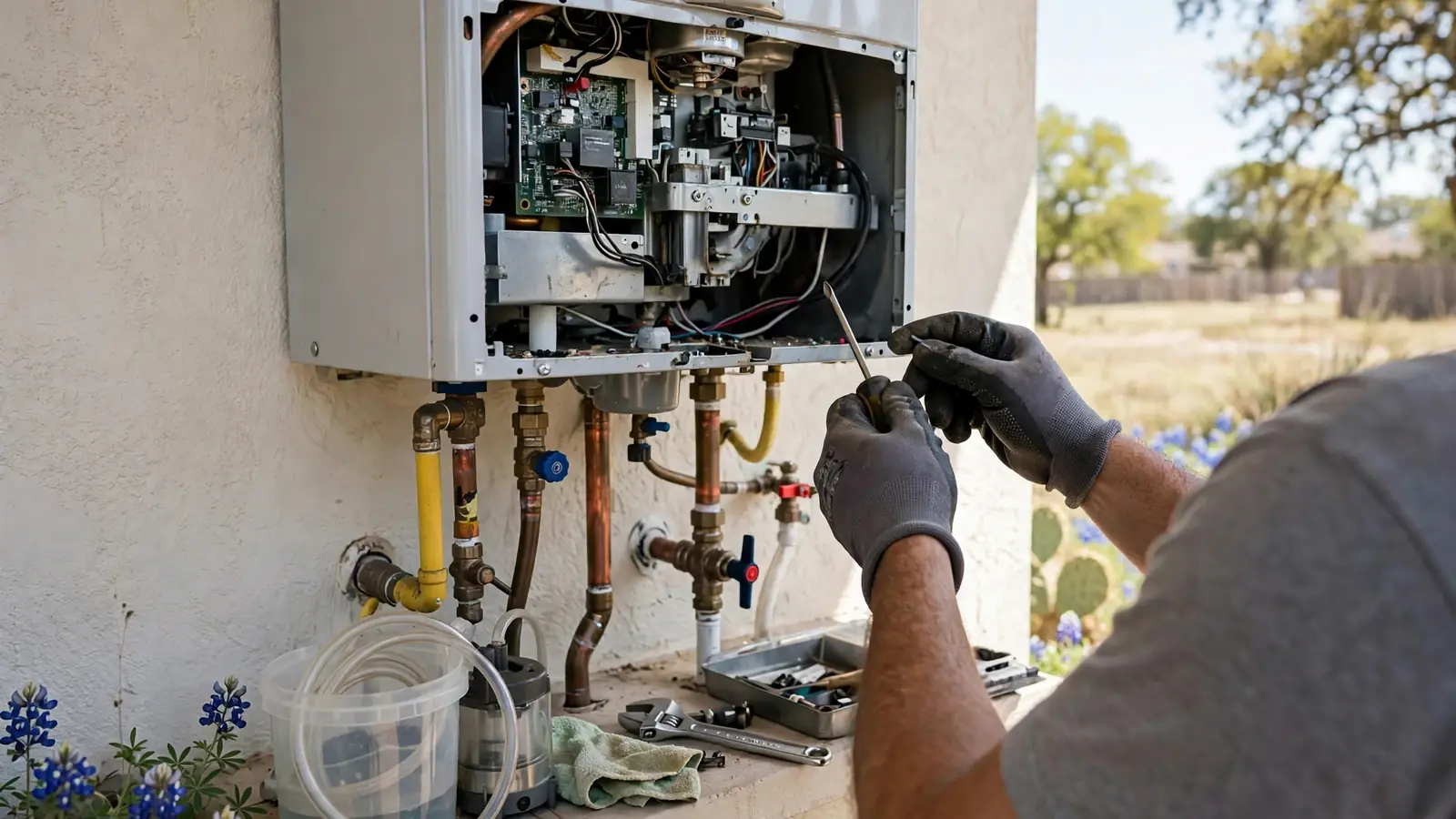
What smart features really do.
Most smart tankless units connect to home Wi-Fi and a phone app. Typical features include setting temperature, scheduling, viewing usage, receiving error codes and sending diagnostic information to a technician. Some also detect leaks or let you turn off the unit remotely.
The core job is the same as any tankless heater, which is heating water as it flows. The smart layer adds convenience and sometimes faster troubleshooting, but it does not change the basics of sizing, venting and fuel supply.
Smart features and what they are worth.
Our tankless water heater page covers service and descaling.
| Feature. | Useful when. | Limits. |
|---|---|---|
| Remote temperature control. | Different household members want different settings. | Adds little in a simple household. |
| Error code alerts. | You want warning before a bigger failure. | Needs reliable Wi-Fi. |
| Usage tracking. | You want to understand hot water habits. | Savings depend on behavior. |
| Diagnostic sharing. | A technician helps you from a distance. | Not a substitute for a visit. |
| Vacation or schedule modes. | The house is empty for long stretches. | Tankless already saves standby loss. |
What your house needs for any tankless unit.
Gas supply sized correctly.
Tankless units draw a large burst of gas, and an undersized line starves the burner.
Proper venting.
The unit needs the correct vent material and routing for combustion gases.
Electrical power.
Even gas models need power for the fan and controls.
Wi-Fi reach.
A smart unit needs a stable signal where it is mounted.
Water supply and pressure.
Adequate flow and pressure keep the unit firing.
Condensate drain.
High efficiency units produce acidic condensate that must drain properly.
Need a plumber for this?
Call the 24/7 line and a dispatcher will help you right away.
Smart tankless or standard tankless.
Both heat water the same way. Choose smart features if you will use them.
Smart tankless.
- App control and alerts.
- Remote diagnostics.
- Needs Wi-Fi and software support.
- Usually costs more.
Standard tankless.
- Simple controls on the unit.
- No dependence on a network.
- Fewer parts that can fail.
- Usually costs less.
Sizing matters more than software.
The most common tankless disappointment is not the app. It is a unit sized too small, so showers run cool when two fixtures run at once. Your plumber should count fixtures and flow rates, check your incoming water temperature and size the heater for winter, when groundwater is coldest.
If your house has several bathrooms, a laundry and a busy kitchen, ask whether a single unit is enough or whether two would serve better. Getting this right at the start prevents most complaints later.
Choosing and installing one.
Assess the house.
We check gas line size, venting path, power and Wi-Fi reach.
Size the unit.
We match flow rate to your fixtures and winter water temperature.
Install and commission.
We set venting, gas, water and condensate connections, then test.
Set up the app and explain maintenance.
We help you connect the app and schedule descaling.
Rather have a pro handle it?
Call to ask about timing.
Maintenance and what the app cannot do.
A smart unit still needs yearly service. Descaling or flushing the heat exchanger keeps flow and efficiency steady, and the technician checks the burner, the vent and the condensate drain. An app can warn you about an error, but it cannot clean a clogged filter or fix a venting problem.
Keep the app and unit firmware current, and use a strong password on the account that controls the heater. A connected device is a small part of your home network, so treat it with the same care as any other.
Common complaints and how to avoid them.
The cold water sandwich is a short blast of cold between two hot flows, and it happens with many tankless units. Recirculation or a small buffer tank can reduce it. Another complaint is the delay before hot water arrives, which comes from the length of pipe, not the heater itself. A recirculation pump on a timer can help in a large house.
Ask about these before you buy. A plumber who explains the trade-offs honestly is more likely to give you a system that works the way you expect.
Stratford note: soft water and permits.
Aquarion's 2025 report for the Eastern Fairfield County system, which serves Stratford, lists average hardness at about 3 grains per gallon. Soft water reduces scale buildup in a tankless heat exchanger, though yearly service is still wise. Ask the Stratford building department what permits apply when you add or change gas and venting.
The same guidance applies to homes in Fairfield and Trumbull on the same water system.
The U.S. Consumer Product Safety Commission urges users to lower their water heaters to 120 degrees Fahrenheit to reduce the risk of tap water scalds, so ask the plumber to set the thermostat with that guideline in mind.
Is it worth it for you.
Smart tankless makes sense if you like monitoring, travel often, want alerts or work with a technician who can read diagnostics. It makes less sense if you have unreliable Wi-Fi in the utility room or just want simple, quiet hot water.
If your existing tank is failing, compare options at the same time. Our water heater installation page explains how we plan new units, whether tank or tankless.
Questions we hear.
A tankless unit with Wi-Fi and an app for control, alerts and diagnostics.
Tankless units avoid standby loss. Smart features can help you track and adjust use but do not change the basic efficiency.
The heater still heats water. You lose app features until the connection returns.
Aquarion's 2025 report lists average hardness at about 3 grains per gallon in the Stratford area, so scale is slower to build, though service is still recommended.
Rules vary. Ask the Stratford building department for your project.